Yellowstone National Park is famous for its geysers, hot springs, and steaming vents. But the most powerful and mysterious force lies underground, this is the Yellowstone supervolcano that has shaped the park’s landscape for millions of years. In this guide, we’ll explore Yellowstone’s hydrothermal features, calderas, eruptions, and volcanic history that make it one of the most unique places on Earth.

Yellowstone River Steam Vents – USGS – Pat Shanks
Beneath Yellowstone’s hiking trails and valleys lies a massive magma chamber. This molten rock sits unusually close to the Earth’s surface, heating water that escapes as geysers, hot springs, and fumaroles. Because of this, Yellowstone is not just a geothermal hotspot — it is also an active volcanic system.

Yellowstone Caldera’s Map – USGS – Volcano Hazards Program
Yellowstone is classified as a supervolcano because its past eruptions were massive — ejecting over 1,000 cubic kilometers of ash, gas, magma, and rock. In fact, Yellowstone has erupted three major times over the last 2.1 million years, reshaping the entire region.
About 2.1 million years ago, Yellowstone’s first super-eruption formed the Huckleberry Ridge Caldera, spreading volcanic ash as far east as Missouri. This enormous caldera measures 53 by 28 miles, forming the foundation of the volcanic system.
Roughly 1.3 million years ago, a smaller eruption created the Henry’s Fork Caldera. With a diameter of about 10 miles, it sits at the western edge of the original caldera.
The most recent major eruption occurred 631,000 years ago, forming the Yellowstone Caldera — a depression about 30 by 45 miles across that dominates much of today’s park.
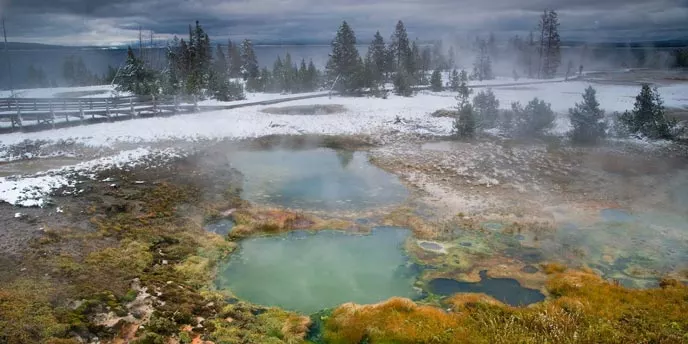
West Thumb Geyser Basin – Yellowstone National Park NPS – Damon Joyce
Since the last super-eruption, Yellowstone has seen around 80 smaller eruptions. One of the most notable formed the West Thumb of Yellowstone Lake about 174,000 years ago. Today, visitors can explore the West Thumb Geyser Basin, a scenic spot where hot springs like the Abyss Pool and Fishing Cone bubble along the shoreline.
Yellowstone’s surface still shows signs of movement. Areas of uplift, known as resurgent domes, appear as the magma chamber below shifts. Two prominent domes — Sour Creek and Mallard Lake — rise and fall over time, monitored closely by scientists.
Experts say Yellowstone will erupt again — but when and how are uncertain. A full-scale super-eruption would have global consequences, sending ash across North America. More likely, however, are smaller hydrothermal explosions or lava flows, which would be localized but still dramatic events.
From steaming geyser basins to the rim of the Yellowstone Caldera, the park offers countless opportunities to witness the results of this powerful supervolcano. On a guided tour with Tied to Nature, you can explore Yellowstone’s geology, wildlife, and hydrothermal features while learning the stories behind the landscape.
https://www.britannica.com/place/Yellowstone-National-Park
https://www.nps.gov/yell/learn/nature/volcano.htm
https://www.nps.gov/articles/000/resurgent-calderas.htm
https://www.usgs.gov/media/images/simplified-map-yellowstone-caldera
https://www.usgs.gov/media/images/steam-vents-along-yellowstone-river-near-mud-volcano-thermal-area
https://www.nps.gov/yell/learn/nature/west-thumb-geyser-basin.htm
https://education.nationalgeographic.org/resource/when-sleeping-giant-awakes/


